And twenty years later...they still look the same...
Wednesday, December 20, 2006
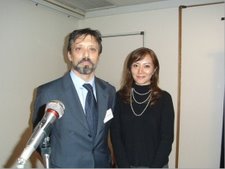
My ageless friends...photos of us 20 years ago!!!!
I am sorry...I just had to post these photos. Just found them as I was cleaning out my drawers. These are my friends since kindergarten...Notice our 80's eye brows...and my "pretend I'm Madonna" hairstyle...


And twenty years later...they still look the same...

And twenty years later...they still look the same...
Wednesday, December 13, 2006
Oral Health Care Part 2: More Scary Facts About Periodontal Disease
In my earlier post, I talked about my encounter with a great dentist, Dr. Toguchi. Not only is he an excellent dentist who believes that dental treatment should not be painful (yesss!!), but he is also a wonderful teacher who doesn’t mind spending time to educate his patients about oral health care. In my last post, I tried to warn everyone about the threat of periodontal disease that comes with aging. Well, as I was getting my teeth cleaned, Dr. Toguchi revealed to me that the third most common cause of death among elderly people (in Japan?) is pneumonia and much of that is actually caused by periodontal disease! “Whaaaat?! People can die from gum disease?!” He told me that elderly people suffer from weak muscles that inhibit them from swallowing properly. So the bacteria infecting the gums can easily go into their bronchial tube and enter the lungs. With suppressed immune systems, these bacteria could easily infect their lungs, thus causing pneumonia. Utterly shocked, I shared this scary fact with my anti-aging advisor, Dr. Andrew, who casually said, “Oh, yeah, that’s how my grandfather died. He had periodontis and the bacteria in his mouth traveled to his brain and caused brain infection …” “Whaaaat?!”
So here are the warning signs of periodontal disease:
1) Red, swollen and tender gums
2) Gums bleeding when brushing or flossing
3) Teeth getting loose
4) Pus between the gum and the tooth
The mildest form of gum disease is gingivitis where your gums swell and bleed easily. People often ignore these symptoms because there is not much discomfort at this stage. However, if gingivitis is untreated, it could advance to periodontis. Like I mentioned before, you cannot regenerate your gums and bones once destroyed so that means periodontal disease is irreversible. The best way to prevent periodontal disease is to remove that deadly plaque on your teeth by brushing. I recommend use of Sonicare with almighty germ-killer, Concool, flossing and getting your gums checked at the dentist regularly. (I will write about how to brush one’s teeth in my next post. Got thoroughly trained last time I was at the dentist.)
Because periodontal disease is a bacterial infection, that bacteria can enter the blood stream and attack any of your major organs and cause new infections. Heart disease which affects a huge percentage of our population can be prevented if you take care of your gums!!
Shinanomachi Dental Clinic Tel: 03-3341-8286 (Dr. Toguchi)
Fujimi Dental Clinic Tel: 03-3563-4022 (Dr. Hitomi Hayashi speaks English)
http://www11.ocn.ne.jp/~asunaro/
Friday, December 08, 2006
Eyelash Extensions--the Next Beauty Fad


Ever wonder how stars like Jennifer Lopez, Nicole Kidman, Lindsay Lohan and Madonna have long lush lashes that seem to be flawless? Most wear eyelash extensions. This new lash extension craze presently sweeping Hollywood actually started in Japan.
I just got back from my monthly eyelash maintenance at Salon de Beaute Araki. I am going to write about my two incredible eyelash doctors, Kazumi Araki and Yoshiko Mochida. The older one gets, the lazier one becomes to spend time in front of the mirror to pretty oneself up. What first interested me to check out this new “art” called eyelash-extensions is the fact that I won't have to spend that extra five minutes in the morning to curl and apply mascara on my eye lashes! You can dump mascara for good! This was good enough motivation for me. However, despite my hopes, and having tried eyelash extensions at several salons, I was always discouraged by the way they looked. You know, like those fake eyelashes my mom used to wear in the 60s. Moreover, it just felt really weird and uncomfortable. Until I met these two young women…whose skills are absolutely amazing. They really can perform magic. First of all, the lashes look natural, of course a bit too long for Asian eyes but…most of all, they are so light that you forget that you have 50 or so extremely fine silk lashes glued on. What I want to rant and rave about is their technique to shape the eyelashes to look so naturally curled without using curlers or perming the lashes. This is actually quite difficult and cannot be performed by anyone. They run a small cozy salon near Ebisu station but since celebrities started to recommend them in beauty magazines, it has become a popular spot for women who desperately need to boost up their lashes. You will have to book way in advance but I think it is definitely worth it! (FYI, I am using the shortest extensions that match the length of my own lashes to get a natural look. Touch ups needed every 2-3 weeks) Sorry, promise to write about serious anti-aging stuff next…
http://salondebeautearaki.com/silkylash.html
Sunday, December 03, 2006
Music and Healing
Sound is an extremely powerful tool for healing and spiritual transformation. For years, sound has been used to induce states of physical, mental, and emotional relaxation. Sound allows us to enter and tap into the inner resources of our life to retrieve positive energy, renewed vitality, balance, inspiration, relaxation, creativity, free expression, and transformation.
Music helps us to fuse with that inner emotional self. When your emotional self is vibrant and energized, that will also lead to the revitalization of the physical self. Even Buddhism stresses the importance of "oneness of body and mind." So, I believe music has true healing power!
I was definitely re-energized last night! David Murray, my favorite jazz tenor saxophonist, and my good old friend is in Tokyo! I think his ballads are absolutely amazing, especially when he plays "In a Sentimental Mood"--talk about a real healing experience! And when he played my favorite piece, Thelonius Monk's "Let's Cool One,"I felt truly energized!! My friends, jazz-crazy Mr.G and Ms.J joined me last night. It was Kumiko Ishiwata's (music promoter, also known as "rabbit") birthday and David dedicated a solo for her.
Technorati Profile
Saturday, December 02, 2006
Nutri-Genomics? The New Anti-Aging Solution?


Well, I was going to touch on a simple anti-aging topic in my next post, like health benefits of pistachio nuts but tonight I attended an interesting conference where two anti-aging medical experts lectured on “Nutri-genomics.” (What’s that?!) Dr. W. Moon made an innovative proposal on tailor made anti-aging solutions based on genetic testing. Dr. F. Marotta talked about the relationship between gene and nutrition and shared with us clinical test results of how certain nutrients can have positive effect on people of a specific geno-type and negative effect on another. Actually, this is quite an eye-opening statement!
For example, we all know fish oil like Omega 3 is supposed to be an effective anti-aging nutrient. So does this mean that Omega 3 will have positive effects on everyone? He is saying, “Sorry, no! There is no “one size fits all” diet.” Omega 3 fish oil can be a great health benefit for let's say geno-type 1 people but can worsen the condition for another geno-type person. So his take is that these nutriceutical solutions, including taking "supplements," are not that simple. If you're the wrong geno-type, not only are you wasting your time taking a particular supplement, but it could even aggravate your health.
Note: Omega-3 is high in two fatty acids crucial to human health, DHA and EPA. These two fatty acids are pivotal in preventing heart disease, cancer, and many other diseases. The human brain is also highly dependent on DHA - low DHA levels have been linked to depression, schizophrenia, memory loss, and a higher risk of developing Alzheimer's.
When catechin was announced as a powerful anti-oxidant, companies rushed to market green tea-related supplements. And we all believed that green tea is good for your health. However, if you don't know your geno-type, you would not know if catechin actually works for you, what kind of catechin is effective for you, how much and how often you're supposed to take it. Without such precise diagnosis, you may be doing something quite meaningless!
So both of these doctors are urging that accurate gene test and analysis is necessary for an optimal nutraceutical program to be designed just for you. Genetic information to tailor make your health care…sounds to me like the next generation of medical practice!
Wednesday, November 29, 2006
Your gums age, too! Importance of Good Oral Health


Forgot that your gums age, too...
I went to the dentist today and came home determined, absolutely determined to take care of my teeth and gums.
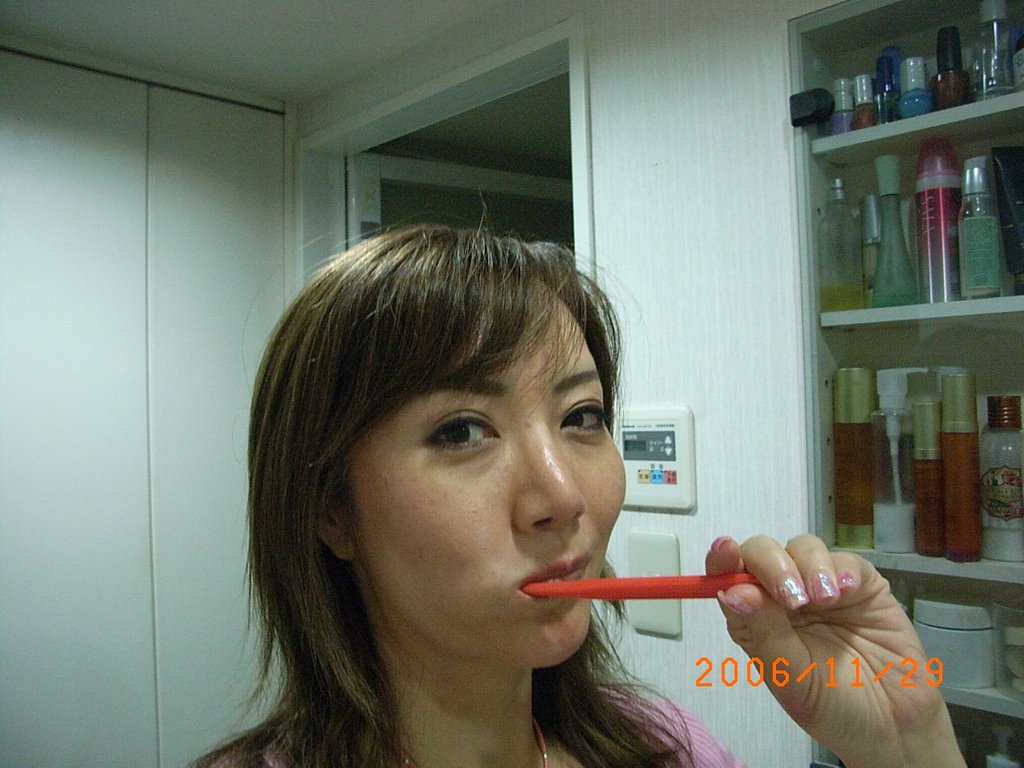
My dentist told me that if I don’t change the way I brush my teeth, I may soon face serious consequences with my gums. So I sat there with my little red tooth brush that he handed to me, like a trained dog being watched, to practice in front of him. As instructed, I tilted the bristles at 45 degree angle against the gums, focused on brushing in very small horizontal movements, imagining hard that your hand suddenly turned into Sonicare. As his piercing eyes followed every movement of my red tooth brush, I realized I was sweating from nervousness...
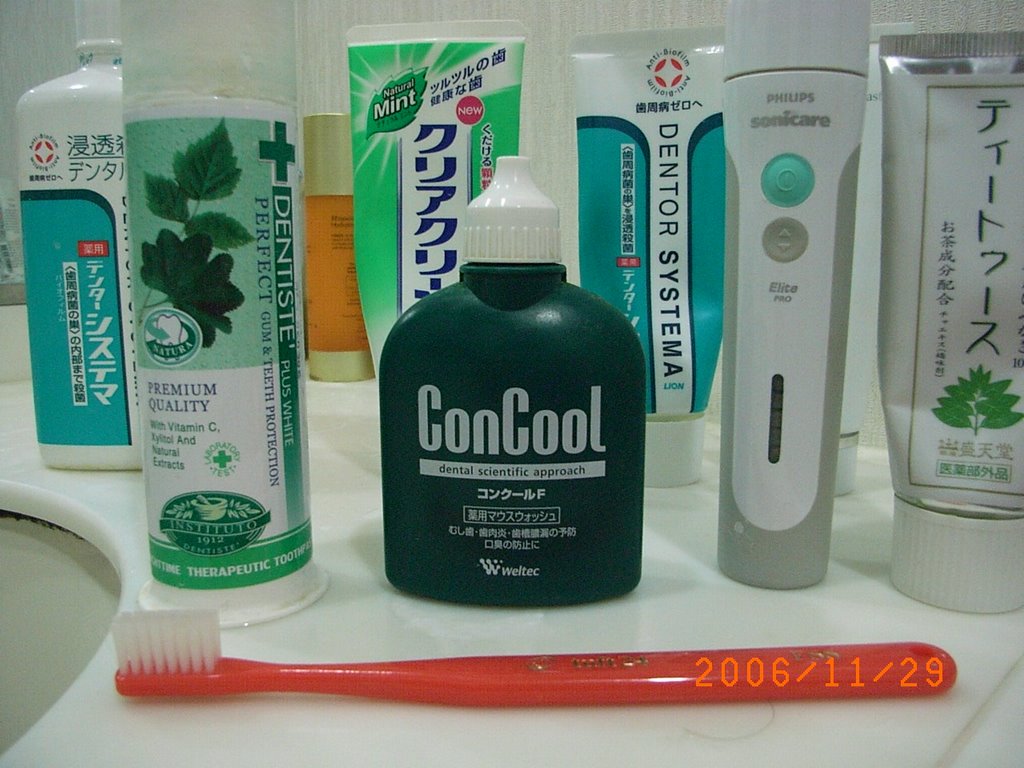
I thought I was following a pretty strict oral care regimen until today. Look at these so-called periodontal-preventative products lined up on my sink! Apparently, the most powerful of all is this minty green liquid called “ConCool.” My dentist tells me that its germ-killing power is no rival to any of the oral hygiene products out in the market.
Periodontal (gum) diseases, including gingivitis and periodontitis, are serious infections that, left untreated, can actually lead to tooth loss. Periodontal disease is a chronic bacterial infection that affects the gums and bone supporting the teeth. And this type of inflammation gets worse as you age (because of your immune system getting weaker) so better act now before it is too late!!
Periodontal disease begins when the bacteria in plaque causes the gums to become inflamed. If you don’t fight that plaque, which you may not take too seriously, it will spread under your gum line without you knowing. The toxins from this hardly visible “plaque” will cause chronic inflammation which will slowly but surely destroy the tissue and bones that support your teeth. The tricky thing is, it is not painful, so this can continue unnoticed. By the time your gums start to bleed, you are in trouble. If you leave that untreated, soon your gums will start to thin out, creating pockets between your teeth and gums. The pocket deepens and the next thing you realize, your teeth are loose… you have no teeth…
Cigarette smokers are susceptible to periodontal disease so be careful! Also, women going through menopause should be aware that hormonal fluctuations can seriously affect your gums. Surprisingly, according to research, more than 30% of the people are genetically susceptible to gum disease. Despite aggressive oral care habits, these people may be six times more likely to develop periodontal disease. So they have to go through preventative treatment at an early stage to keep their teeth intact. Furthermore, stress can be a big risk factor that can cause periodontal disease. When you’re under stress, your body cannot fight off the germs and infections. According to my scary but concerned dentist, Dr. Toguchi, most people have some kind of gum infection so you don’t need to panic. But the scary thing is, once your gums recede, you cannot reproduce them again. They will not heal like the rest of your body heals after a cut. The best you can do is to maintain what you have.
So you see, the key is to make your body healthy and strong to fight off the infection inside your mouth while making an extra effort to remove that annoying plaque!
Monday, November 27, 2006
Vitamins...Natural vs. Synthetic??
Did you know that most of the vitamins and nutritional supplements you find on the shelves of drug stores are made synthetically through chemical processes, rather than derived directly from plants or other natural materials?
Some health authorities claim that these synthetic vitamins are useless and ineffective. If your body cannot absorb the nutrient, it becomes toxin in your body and later excreted. However, there are some orthodox doctors who claim that synthetic vitamins have a molecular chemical structure identical to the natural vitamin and that they are just as effective. So who’s telling the truth?
First of all, it is tricky to define what a “natural vitamin” is but it is usually defined as “a concentrated nutrient derived from a quality natural source. The key is maximum retention of the natural material; no artificial colors, sweeteners, or preservatives should be used. Nutrients are concentrated from its natural source as carefully as possible. (This is where the patented technology of each manufacturer will become a crucial factor!) No extreme heat, pressure, or possibly toxic solvents are used. There are no sugar or chemical tablet coatings. The nutrients are prepared from high quality raw ingredients and no artificial chemicals are added.” So, processing is limited in order for natural ingredients to be retained.
On the other hand, synthetic vitamins are made in a lab setting from coal tar derivatives. Most of the food supplements sold on the market today are synthetic and often cheaper to produce than natural vitamins. So the key issue here is…is the molecular structure of natural vitamins altered by the synthetic process or not?
My anti-aging advisor, Dr. Andrew, the other day revealed to me that our cells are pretty smart. Even if synthetic supplements have identical molecular structure as its natural counterparts, somehow our cells can detect the difference!! “They will reject anything synthetic…”, he says.
So are all so-called “natural vitamins” equally effective? The downside of “natural” supplements is in its lack of dose consistency. In nature, one orange might contain 100 mg of vitamin C and in another, only contain less than 20 mg. The retention of natural ingredients depends on various conditions like time of harvest, climate, storage conditions, etc. So the manufacturer will have to invest a lot of money to standardize and manage quality in such a volatile environment. This is really costly for the manufacturer and that is why most of the supplement products you see in the market are synthetic. We need more information on manufacturers that have R&D capabilities to provide quality vitamins at affordable price for consumers.
Quality in vitamins and nutrients is extremely hard to quantify especially when one cannot simply trust that what you find inside the bottle is what is written on the label. So what do I do? Well, supplements are called supplements because they are supposed to supplement the nutrients you gain from eating healthy food. However, with most of the vegetables and fruits (in Japan) made in hot houses these days, the amount of nutrients you find in there are much less than what were found decades ago, so I definitely think there is health benefit in taking supplements.
My anti-aging doctor recommends multi-vitamins from companies like Pharmanex. Otherwise, I would purchase supplements from pharmaceutical companies that are known for outstanding R&D technology. My recent health “fad” has been to eat lots of pistachio nuts and dried fruit because they are after all great “natural supplement sources.” Will talk about that in another post.
Some health authorities claim that these synthetic vitamins are useless and ineffective. If your body cannot absorb the nutrient, it becomes toxin in your body and later excreted. However, there are some orthodox doctors who claim that synthetic vitamins have a molecular chemical structure identical to the natural vitamin and that they are just as effective. So who’s telling the truth?
First of all, it is tricky to define what a “natural vitamin” is but it is usually defined as “a concentrated nutrient derived from a quality natural source. The key is maximum retention of the natural material; no artificial colors, sweeteners, or preservatives should be used. Nutrients are concentrated from its natural source as carefully as possible. (This is where the patented technology of each manufacturer will become a crucial factor!) No extreme heat, pressure, or possibly toxic solvents are used. There are no sugar or chemical tablet coatings. The nutrients are prepared from high quality raw ingredients and no artificial chemicals are added.” So, processing is limited in order for natural ingredients to be retained.
On the other hand, synthetic vitamins are made in a lab setting from coal tar derivatives. Most of the food supplements sold on the market today are synthetic and often cheaper to produce than natural vitamins. So the key issue here is…is the molecular structure of natural vitamins altered by the synthetic process or not?
My anti-aging advisor, Dr. Andrew, the other day revealed to me that our cells are pretty smart. Even if synthetic supplements have identical molecular structure as its natural counterparts, somehow our cells can detect the difference!! “They will reject anything synthetic…”, he says.
So are all so-called “natural vitamins” equally effective? The downside of “natural” supplements is in its lack of dose consistency. In nature, one orange might contain 100 mg of vitamin C and in another, only contain less than 20 mg. The retention of natural ingredients depends on various conditions like time of harvest, climate, storage conditions, etc. So the manufacturer will have to invest a lot of money to standardize and manage quality in such a volatile environment. This is really costly for the manufacturer and that is why most of the supplement products you see in the market are synthetic. We need more information on manufacturers that have R&D capabilities to provide quality vitamins at affordable price for consumers.
Quality in vitamins and nutrients is extremely hard to quantify especially when one cannot simply trust that what you find inside the bottle is what is written on the label. So what do I do? Well, supplements are called supplements because they are supposed to supplement the nutrients you gain from eating healthy food. However, with most of the vegetables and fruits (in Japan) made in hot houses these days, the amount of nutrients you find in there are much less than what were found decades ago, so I definitely think there is health benefit in taking supplements.
My anti-aging doctor recommends multi-vitamins from companies like Pharmanex. Otherwise, I would purchase supplements from pharmaceutical companies that are known for outstanding R&D technology. My recent health “fad” has been to eat lots of pistachio nuts and dried fruit because they are after all great “natural supplement sources.” Will talk about that in another post.
Subscribe to:
Posts (Atom)